07 July 2011

Beijing Fog.


Smog at the Olympic Village. Beijing.

Now would also be a good time to mention the smog of Beijing. You’ll notice that my pictures are quite hazy, and that’s thanks to the giant steel mills and coal burning power plants outside of town, and the huge numbers of cars, construction projects, and motorbikes. According to the World Health Organization, Beijing has pollution levels almost 7 times that of New York or LA, and the US Embassy issues periodic warnings to remain indoors…The air was so thick you couldn’t see more than ¼ mile sometimes, and I definitely walked through acetone-smelling clouds. Yum! When we left town to see the Great Wall, it was like a curtain was lifted, and we could see the sky again. We only had one sunny day in Beijing; otherwise, the smog and clouds blocked the sun. 

The trip out of town on the Trans-Mongolian was the same way for the first 4-5 hours – coal plant after coal plant, factory after factory. The air was yellow-brown. The water was filthy, and filled with trash. People lived in houses and apartments right next to these places, children were playing in streets that were completely black with coal dust. We had to shut our window, as a layer of black soot soon coated everything in our compartment. The countryside was stripped, there was bare dirt everywhere. Everyone should see this: people who oppose environmental regulation, people who have their head in the sand about environmental change, people who think an unregulated economy will benefit anyone other than those at the top, people whose hearts break [or don't break] at the thought of what our lifestyle costs others.

I think it's safe to say that next time I am faced with buying something cheap that was made in China, I will now better understand some of the long-term costs of doing so. Someone has to pay, and right now, it seems like it’s the 9 year old kids working in factories producing cheap goods, and playing in coal dust after their shift. [Check out Peter Hessler’s books for more info/commentary on this…]

I don’t believe one travels just to see beautiful things, or prepackaged cultural experiences. I am just as interested in seeing a back-alley construction project as I am in being herded through the Forbidden City. One woman told me last night to get out of Ulaanbaatar as fast as possible – “It’s not a nice city, you know.” And, she may be right. But I’m not traveling around just to see “nice” things, but how people live. Many millions more people live in Soviet-era block housing than in gers [although about half of Mongolians live in gers], so I should probably find out more about it. And anyway, I’ll be out and about in the countryside all next week, and yes, I’ll probably like it better. 

06 July 2011

Bird's Nest, PS.


I'm definitely seeing some funny things on my travels, and architecture is a constant source of mirth and ridiculousness, unfortunately. Here are some of my favorite moments at the Olympic Village. 

I hate those dumb giant light fixtures. Are they lily pads? Ugh. They were overwhelming and overbearing in person. At one point, I could look straight ahead and count 9 different outdoor lighting fixtures in view. The spaces surrounding and connecting these buildings were definitely their weakest points: a mish-mash agglomeration of weird site planning.

Giant lily pads at the National Stadium, Beijing.

Design 101: miniaturizing your building is never a good inspiration for light fixtures or recycling containers. 

Light fixture, National Stadium, Beijing.

Trash and recycling containers, National Stadium, Beijing. Note the stylized "Bird's Nest" motif. Nice.

And finally: is this the Architect’s triumph or tragedy: Whole themed gift shops on your building, featuring necklaces, socks, t-shirts, lunch boxes, paper weights, note paper, cut crystal replicas...?!

Gift shop at the National Aquatics Center ["Water Cube"], Beijing.
 And, I know it's been done before, but here are my favorite signs from the Olympic Village:

"The grass is smiling at you please detour." In the Olympic Village dragon-shaped lake park.

"Beautiful art comes from your kind soul." Completely random location at the base of a wall.

CCTV, Bird's Nest, and Water Cube.


All in one day! CCTV was disappointing, because there was a huge wall surrounding the building, and we couldn’t get anywhere near it. Could’ve had something to do with the big fire that happened there a couple of years ago, that CCTV famously didn’t even report on. But, it was good to see it and get a sense of the scale. It was HUGE.

The Bird’s Nest and Water Cube were both pretty great, and I was prepared to not like them. The sites were pretty bustling, but in a culture with no big-arena sports, the Bird’s Nest especially is more of a gigantic inhabitable sculpture. Not that there’s anything wrong with that conceptually, but it does seem a colossal waste of space, money [$15 million/year upkeep!], and resources. The Water Cube at least has a water park inside, which was completely packed when we were there…

The Bird's Nest also brought up nagging questions about complication of building forms. For me, shapes like the Bird's Nest are beautiful, but not expressive of much other than that form - certainly it's not tied to any expression of the materials or the construction methods. The welded seams in the metal cladding around the steel structure were clearly visible, and had little to do with the abstract [and I mean abstract from construction logic] shapes of the architecture. Here is an example of something modeled in a computer program, then shoehorned into existing construction methods and made to look as if it were spun from string or whatever. I guess I'm usually in the opposite camp, where the construction methods, materials, or hybrids thereof inform the form. In either case, though, "honesty" of form, material, method comes into play - I think, as usual, the designer has to choose what to lie about.

CCTV Building, OMA, Beijing.

National Stadium ["Bird's Nest"], Herzog and deMeuron, Beijing.

National Stadium ["Bird's Nest"], Herzog and deMeuron, Beijing.

National Aquatics Center ["Water Cube"], Herzog and deMeuron, Beijing.


Museum design, by committee.


Before heading out to Beijing, I spent the weekend in Philadelphia, and walked past Williams and Tsien’s new Barnes Museum several times. I really liked the “back” façade, with its composition of alternating concrete panels and window slits. I really hated the “front” façade – the huge traditionally mulled windows in all different shapes looked completely out of place, punched arbitrarily into the gridded composition established by the panels and slits. It looked like design by committee, but a committee that took two opposing opinions, and could only come to an awful standoff. Or, someone hit the "it's too modern!" panic button, and forced the late-game addition of some "traditional windows." 

Design may be subjective, and good taste is certainly defined by the taster, but sheesh... There are more sensitive ways to relate to a historic context than collaging pieces and parts into a Frankenstein façade, which, surely, these architects wouldn't have done if given latitude to do their own work. 

Ok, climbing off my soapbox. 


"Front" facade.

"Front" facade.

"Back" facade.

In Search of the Internets.

Turns out keeping up with a blog is harder than it seems. Especially if you're in China, where Blogspot [and many other websites, like Facebook, Blogger, and YouTube] are blocked. So, I had to come to Mongolia to get reliable internet...

We just arrived in Ulaanbaatar via the Trans-Mongolian Railway, and I'm sitting in the windowsill of my Soviet-era guesthouse, surveying the scene below - a construction site [solid brick walls with a layer of insulation inside!], cats on the roof below, and lots of Mongols dodging the raindrops. I'll try to get caught up from PA, then China, then here. 

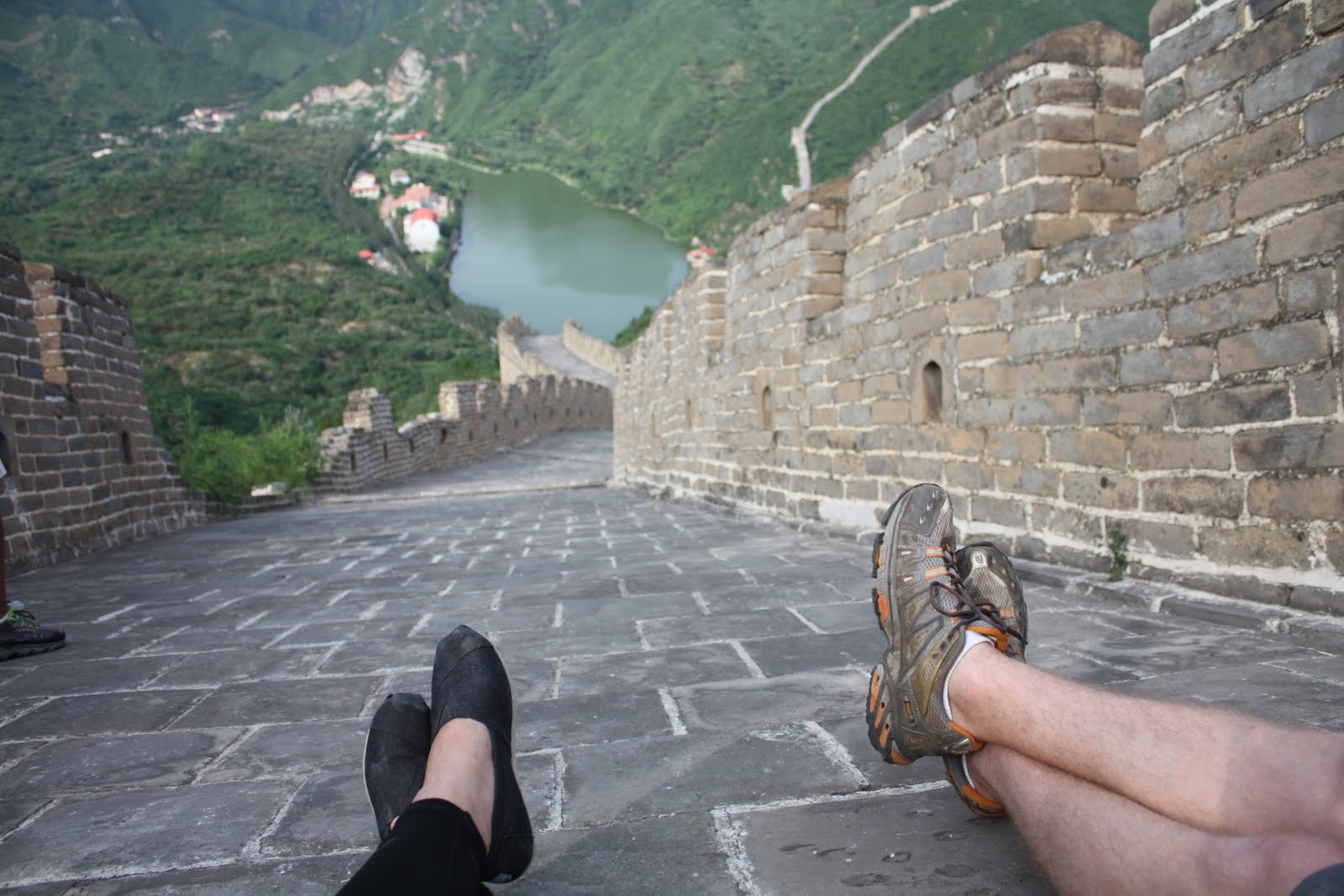
Meanwhile, Jon and I at the Great Wall, on the 4th of July:


 More coming soon!

14 June 2011

The Jamaica I Know, Part II.

Boats at the fishing village next to Clinton's cafe. The fish go directly from the ocean to these boats to the cook's pan to your plate. I had snapper and lionfish.

Aerodynamic egrets.

A Rasta food shop.

At the Hamden distillery, where they make a distinctively aromatic rum, that lives up to its name ["Rum Fire"]...The distillery is run by two brothers - no recipes are written down, no formulae, nothing - just traditions and methods passed down by word of mouth. The molasses on the floor of the distillery was at least 2" thick.

Tinsley house, out in the countryside of Trelawney Parish. The going is slow in these parts - huge potholes, goats, etc. Note the sugarcane growing in the fields in the foreground...

The town of Falmouth, from the Anglican church tower. This pic is from last year, so the cruise ship wharf is not completed yet.

09 June 2011

The Jamaica I know [Pt 1]

Rosie's hair salon, down the street from the manse. THE place to go for braids.

Albert George Market, c. mid 19th century, in Water Square, Falmouth.

Around Falmouth.

My favorite sign in town: Dee and Pee's Records and Children's Boutique.


Here are some photos from around Falmouth that I took this morning. I'm not sure of the percentages, but I would venture a guess that 90-95% of tourists that come to Jamaica don't make it outside their all-inclusive resorts. Most Americans [in my experience] don't think of Jamaica as a place with something besides beaches, rum punch, and reggae, or an architecture and a history worthy of investigation. I'm not sure why, but it's disappointing.

In any case, I feel privileged to have spent about two months here so far, and hope to come back - even [especially!] to the Manse, with its spotty running water, mosquito nets and bunk beds, porridge breakfasts, and zero AC. At this point, honestly, I would be kind of disappointed if those things changed.

As an almond falls from the tree over my head, and to the sounds of the table saw, I think I'll eat a mango from this tree over here.