25 August 2011

Villa Sentosa.

While in Melaka, I stopped by Villa Sentosa, in Kampung Morten, Melaka. This area was settled in 1920, when the British relocated people here from another part of the city slated for redevelopment. The houses here are traditional Malay houses, and I was fortunate enough to be led around Villa Sentosa by a family member. These houses place primary importance on ventilation, and through various openings, shutters, doors, and vents, keep the occupants cool. The ambient temperature when I visited [late afternoon] was a full 10 degrees cooler inside than outside. The houses are also raised above the ground, which, in addition to having various climatic advantages [ventilation, flood protection], provides a very useful work/laundry drying/storage space that's shaded and protected.

So now I'm wondering: how many of these techniques can be seen in the Dutch and British buildings, and what are the reasons these houses were [and are] still being built? Is it a matter of location [urban, commercial district, village, rural, etc?] And, of course, how well do they perform climatically? [Everyone draws those magic ventilation arrows...how is air really moving through the space?]

House in Kampung Morten, Melaka.

Visiting room, Villa Sentosa, Melaka.

Exterior of visiting room, Villa Sentosa, Melaka.

Interior, Villa Sentosa, Melaka.

Living room, looking into central "courtyard" and dining area beyond, Villa Sentosa, Melaka.

17 August 2011

A Perfect Lunch.


Mango lassi and laksa!

Shophouses, or, the persistence of form.

Front room in a new shophouse, Hoi An, Vietnam.


Hoi An's "ancient houses" [meaning 18th and 19th century] are mostly shop houses - a shop or business on the ground floor opening onto the street, with living quarters behind and above. I saw a similar pattern in Hanoi with the tube houses, and found more recently in Kuala Lumpur, in Chinatown and Little India. What is interesting to me is that these forms [shop house, tube house] continue despite the disappearance [or evolution] or the original impetus for developing that form - especially in Vietnam.

For example, new vernacular houses in Hoi An seem to have the large, open front room opening onto the street, even when the house doesn't have any commercial activities on the premises. Walking down the street at night, I saw house after house with the lights on, TV blaring, and no one in these rooms. It was very strange. I could hear voices, but people seemed to be either in the back room, or in the upper rooms. It was as if the shop, which had historically occupied that space, had disappeared, but habitation patterns hadn't quite caught up yet.

The shop house, or tube house, form, though, also seemed to persist in suburban areas as well, where presumably there are no zoning/tax regulations [the impetus for tube houses in Hanoi] or historical precedent or commercial need on the site [the impetus for shop houses in Hoi An]. We saw these on our bike ride out of Hoi An to the beach, which was 3 miles outside of the town, and also on the plane flying out of Da Nang. New suburban homes were clustered together in the middle of rice fields, densely packed and at least three stories tall. Could it be a need/desire to preserve land for rice fields? Or is it, like the Mongolian ger, an architectural, formal [maybe even cultural] given? 

Unlike the ger, however, the "new vernacular shop house" no longer responds to the original factors that determined its form, because those factors have disappeared, or changed. This is why new vernacular architecture fascinates me. People build houses in a certain way because "that's what a house is" - its form and appearance are coded in spatial organization, color, trim details, and where the car [or motorbike] goes. That code, in turn, is deciphered using historical references filtered through cultural, economic, and societal definitions [rather than, perhaps, actual understandings of history]. I think this can lead to an unfortunate understanding of architecture as a series of eras marked by pat names [Victorian! Greek Revival!], but I think that in reality, it's much more complicated.

I'm more interested in deciphering patterns of occupation, or clues as to the dissemination of culture, building and climate mediation methods...and of course, the point at which the exigencies of climate outweigh the traditional imperative of culture: the moment of innovation in the evolution of form. 


I may have found one today, at 8 Heeren Street, Melaka. Not just the house itself, but the house + the place + some good conversations I've had over the past couple days with some very interesting people. Stay tuned. I have to anyway, since I don't know what it all means yet. 

Not a shophouse: Villa Santosa [c. 1920], Kampung Morten, Melaka, Malaysia.


13 August 2011

My First Mosque.

While in KL, I went to Masjid Jamek - it seems a bit hard to believe I've made it this far into my life without visiting a mosque. I donned the provided robe and headscarf, and started exploring. It was very clear what areas were off limits to non-Muslims [so many signs!], but I appreciated that we were allowed to move around the space and take pictures, even as people were at their prayers inside.

Like a gothic or renaissance church, there was a clear separation between worshiper and visitor, with clear circulation patterns outlined for both - as I processed around the perimeter of the building, I could observe what was happening inside without disrupting it. Both create the separation of circulation using ceiling heights and columns: in the Christian churches, the side aisles' ceiling is lower then the central nave; at this mosque, the visitor's circulation path was not covered, whereas the prayer areas were. Similarly, the use of columns in both to create a permeable, yet clear boundary between uses is elegant and effective. Looks like I need to look more into mosque design to see if I'm just making all this up - ARH 101 was a long time ago...

I couldn't help but think, however, that the contemporary occupants of the mosque ought to rely more heavily on the clear architectural clues that the original designers and builders employed, rather than sullying the place up with a bunch of impermanent and shouting signs.

In any case, it was a much-needed respite from the city, complete with palm trees, fountains, and cool white marble - and my visit was only cut short by the fact that, in 100 degree heat, I was clad head to toe in polyester.


Mosque-ready attire.

Masjid Jamek, built in 1907, KL.

The building stands on a point of land where two rivers come together in KL. If ever there was a place of tranquility in this crazy city, this would be one of them.

Can't get there from here.

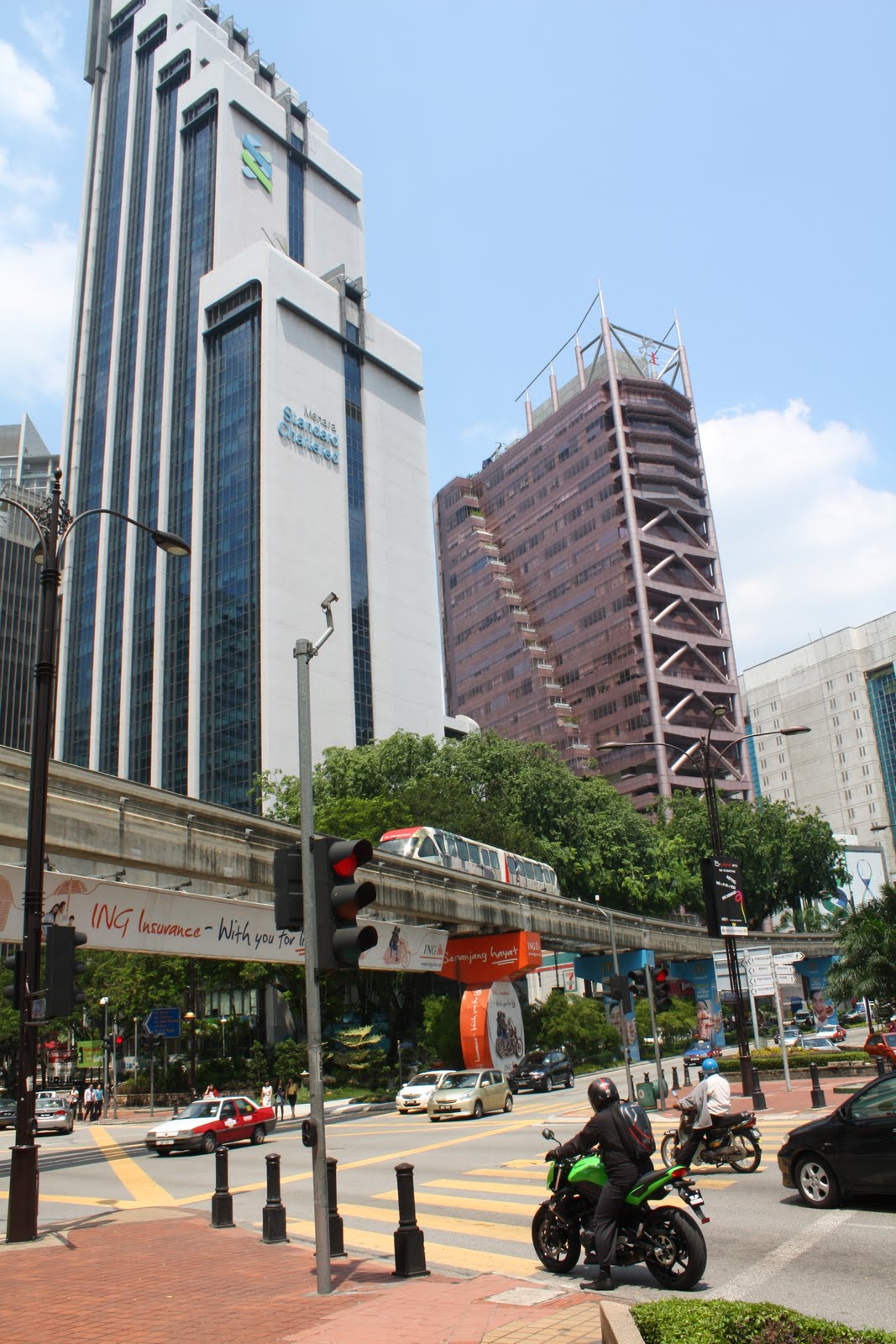
 We set out  to explore KL on foot, which was our first mistake.... I knew it would be difficult, but sheesh. The newer parts of the city [KL City Center, where the Petronas Towers are] are completely pedestrian unfriendly, if you venture beyond the carefully curated pedestrians zones [parks] and paths [connecting bridges among shopping malls]. Heaven help you if you want to get from Point A to Point B on foot. Buildings are surrounded by mazes of car access roads, taxi stands, service areas, etc, and it is very difficult to find a building's "front door," not to mention trying to cut through the super-mega-blocks around KLCC. 

Once we got to Chinatown and Little India, however, the going got smoother. The old fabric of the city [2-3 story shophouses, 5-6 story factories, shops, and apartments] is still very much apparent, if studded with newer hotels and shopping centers. Because the contemporary street is higher than the floor level of the old shophouses, the sidewalks are actually 1-3' lower than the street, and they're covered - it's an area of transition between shops, a shelter from the rain and sun, and most importantly, the sectional transition provides much-needed protection/separation from cars, buses, trucks, and motorbikes for pedestrians.

We didn't bother with the elevated monorails, even though they looked pretty cool - they all required their own tickets, and none of the routes were very useful for us. When we reached our limit of walking, we took taxis ["teksis"], which, despite the official "no haggling" sticker on the side of the cabs, still required negotiation...

I guess this pedestrian unfriendliness stems from the intensity of the climate; it's very hot, and rainstorms happen with barely a moment's notice. Most people jump from air conditioned building to air conditioned car to air conditioned building, and there are very few people walking around outside. But, there's something lost, and when you visit somewhere like Little India, you see what it is: the sweaty crush of people browsing market stalls, the blaring of music over loudspeakers, the smells of street food, and the interaction of thousands of people at once.

Downtown Kuala Lumpur.

Sunken sidewalks, KL.

Lots of art deco factory and shop buildings from the 1930s/40s in Chinatown...

  
Little India, Kuala Lumpur.
Covered street market, Chinatown, KL.

Archi-Candy.

Petronas Towers, Kuala Lumpur, Malaysia.
Yep, they're cool. And made of reinforced concrete, instead of steel - the whole thing sits on 120 meter [!] deep foundations, the deepest in the world. The buildings utilize 23-by-23 meter concrete cores and a series of widely spaced super columns, which help provide 560,000 square meters of column-free office space.*

The lights go out at precisely midnight, which means that even an oil company sees the value in conserving energy....


*Taranath, Bungale S. (2004). Wind and earthquake resistant buildings: structural analysis and design. CRC Press. p. 748.

08 August 2011

A beautiful day in Vietnam.

Today, like the past 10 days, was another beautiful day in central Vietnam. It was a bit cooler, though - only about 93 degrees. [The past few days, it's been over 100, and all we could do was go to the beach in the afternoons...] I visited some houses, meandered around, did some drawings, visited the most delightful  used books shop [run by a jovial American expat named Randy and his black and white kitten], and had another fabulous meal at Mango Rooms [Vietnamese style breaded scallops in peppers and onions! duck breast in chocolate-chili sauce! homemade mango ice cream!]. I even managed to survive two divebomb attacks by cockroaches, the ever-present swarm of motorbikes, and the constant strains of "You buy something?" [Well, almost: purchased two Hoi An style lanterns on the way home from dinner...]

I will miss Vietnam, and Hoi An - this place is pretty special, especially in the evening, after dinner: it's the kind of place you walk to the river to see what other people are up to, you take some pictures, you buy a paper lantern with a candle in it and place it in the river and watch it drift downstream, you grudgingly accept, then come to sort of love, the kitschy side of the town - from the clay-whistle sellers to the giant lanterns [two 15' cats in a basket?!] in the river.

More to come, of course, but first, I'm headed to Malaysia: tomorrow night, I'll be in the shadow of the Petronas Towers. We'll see - I kind of like being in the shadow of palm trees and market-tarps.

Hoi An waterfront.

In the Hoi An market. I'm pretty sure that when you order shrimp [or fish, or chicken, or greens, or whatever] in a restaurant, they just run here, pick up the shrimp, then fix 'em up for you. Delicious!

Fishing net on the Hoi An River.

I WILL follow a sign that looks like this, every time. On the way to Randy's Book Exchange, Cam Nam Island, Hoi An.